

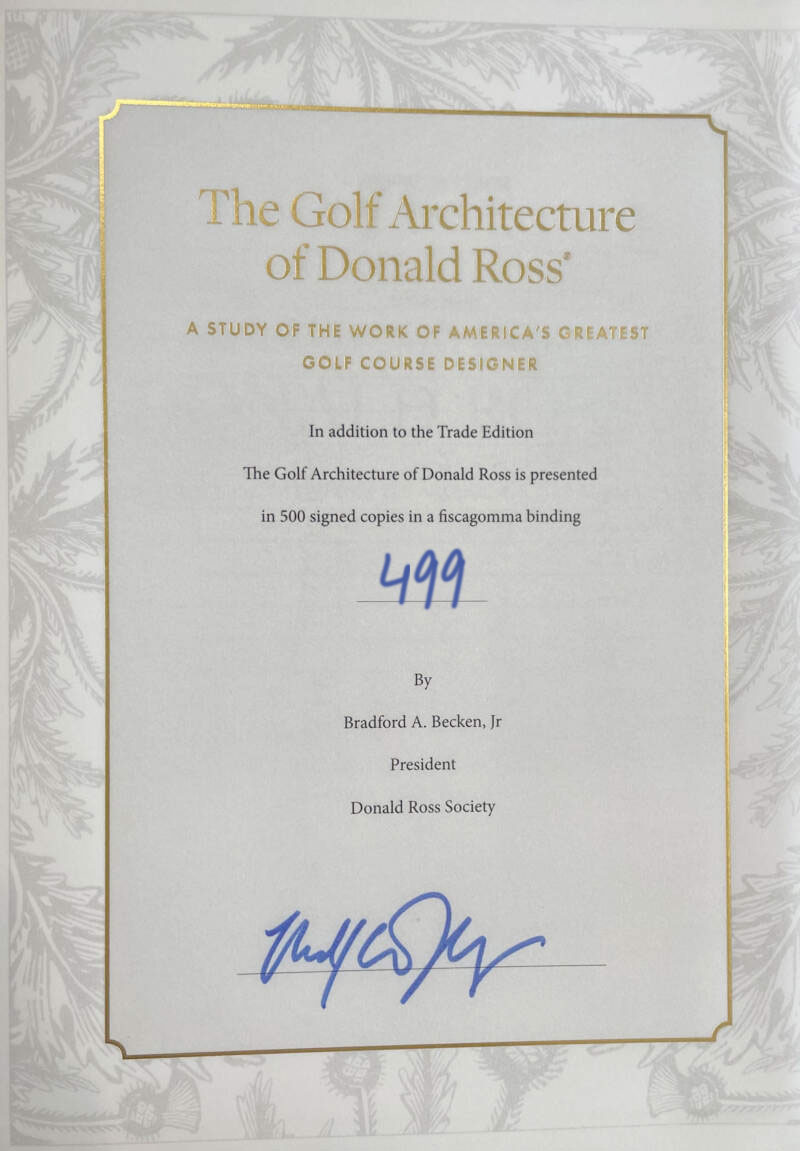
The Golf Architecture of
DONALD ROSS
A Study of the Work of America’s Greatest Golf Course Designer
By Bradford A. Becken, Jr.

SIGNED AND NUMBERED
LIMITED EDITION of 500 copies
384 pages, 9″x12″
$395.00Add to cart
Ran Morrissett Review – January 30th, 2022
By virtue of having worked on over 400 courses across America, in both urban and rural environments, from New England to the Sandhills of North Carolina and the heavier soils of the Midwest, Donald Ross has touched the lives of X million American golfers. To me, no single person has had a greater impact on what constitutes good golf in this country than Ross. To understand how he accomplished so much, read Brad Becken’s The Golf Architecture of Donald Ross. Brad, who has been the President of the Donald Ross Society since 2018, lives 70 miles from me and the time I have spent with him (pic 2) has revealed a man who chooses his words with precision and avoids hyperbole. As such, he makes a most amicable guide as he shares his journey whereby he has played every significant Ross course in America (some that are defunct too). His voice is the unifying factor, so the book enjoys consistency of message. As the title suggests, this is a comprehensive look at Ross’s architecture from routings to bunker schemes to greens to breakdowns of his best one, two and three shotters. If you are an architecture geek, you will get lost in the book for days. The handsome layout includes copious hole diagrams (pic 3, Franklin Hills) and striking photographs and pays appropriate homage to Ross’s five-decade career – no mean feat! Importantly, it is current and as such, it provides excellent insight into which Ross courses you should target next. It pointed me to Belleair (which I just played), and for 2023, Hyannisport, Allegheny (pic 4), Barton Hills (pic 5) and Misquamicut (pic 6) are now on my short list. The Ross Society has done immense good over its 33-year history of unwinding damage to Ross courses while simultaneously helping courses restore Ross features. This book continues that noble cause, and in fact, may well be its crowning achievement. After perusing it, you will be left with no doubt of Ross’s meaning to the game – and how fortunate🙏 we as a country were that the right Scot came along at the right time and shepherded this sport forward in the most meaningful way possible – by building courses that make you itch to play.
Another must-have from the Classics of Golf.
— Ran Morrissett,
Co-Founder Golf Club Atlas

James Dodson Review – October 15th, 2022
Every time we think the proverbial “last word” on the work and legacy of Donald Ross has been written and published, the golf gods seem to send down a different slant — and useful insights — on the incomparable handiwork of America’s patron saint of course design. Such is the case, and engagingly so, of Brad Becken Jr., new book The Golf Architecture of Donald Ross, recent;ly published by The Classics of Golf. Like many of us, Becken takes a deep and loving dive into the classical elements that make Ross’ work so timeless and important — and sadly under siege in many places. Lavishly illustrated and brilliantly detailed in it exegesis of how and why so many of the great man’s courses came about and are still the gold standard today, Becken gives Ross fans (old and new alike) a true insider’s perspective on why a Ross course holds us in its spell. This may not be the final word on the man and his legacy — but it’s certainly one NOT to be missed.
— James Dodson,
Best Selling Golf Author

Chris Buie Review – October 28th, 2022
Donald Ross would have loved Brad Becken. He is sharp and honorable – a true golfer. Becken has not only played all of Ross’s courses but plumbed the significance of the towering portfolio. Every golfer will delight in mulling over this exquisitely crafted presentation of the Scottish master’s work.
— Chris Buie
Author of “The Life & Times of Donald Ross and The Early Days of Pinehurst”

Don Holton Review – October 28th, 2022
It is one of the finest books on golf architecture ever done. Brilliant and thoughtful text; fantastic photos, great layout, and all in all, this is truly a classic. An amazing contribution to the field of golf architecture.
— Don Holton
Historian, Exmoor Country Club

Bradford A. Becken, Jr., the President of the Donald Ross Society since 2018, has visited and played every golf course attributed to Donald Ross:
“The Mission of the Donald Ross Society is to promote the recognition of Donald Ross, the excellence of his golf architecture and the preservation and/or restoration of his courses.”
– Bradford A. Becken, Jr.
President, Donald Ross Society

IMMEDIATE RELEASE
Classics Of Golf Is Pleased To Announce The Publication Of “The Golf Architecture Of Donald Ross – A Study Of The Work Of America’s Greatest Golf Course Designer” By Bradford A. Becken, Jr.
NYACK, NY (NOVEMBER 2, 2022) – Bradford A. Becken,Jr., Donald Ross Society president since 2018, has authored and presented a detailed analysis of Ross’ work relying on approximately 1,500 hole and green and routing drawings that still exist and having played and extensively photographed each one. Starting with the opening of Oakley CC in 1901, Donald Ross, the most important North American architect has 420 design and redesign golf courses to his credit. 370 courses remain today in the US and Canada. The book looks at Ross’ design characteristics and also discusses the restoration movement of Ross’ courses that began in the 1980’s
The new golf architecture book entitled, “The Golf Architecture of Donald Ross – A Study of the Work of America’s Greatest Golf Course Designer” is published by Classics of Golf and is available for purchase at $395.00 at www.classicsofgolf.com. Book specifications: 9” x 12” with 384 pages and a limited-edition of 500 copies, signed and numbered by the author.
All profits otherwise due the author are to be divided equally between The Donald Ross Society Foundation and The Tufts Archives in Pinehurst, NC.
“This book is a unique definitive look at the many Donald Ross courses in the United States and Canada,” said author Brad Becken, Jr. “Over the last several years I have spent a considerable amount of time closely studying Ross hole and green drawings grid line by grid line and closely comparing each current course to the drawings I have reviewed.”
Today, the timeless appeal of Donald Ross’ golf courses is stronger than ever with each such club proudly proclaiming its Donald Ross legacy. Even though the newest Ross design is over 70 years old, major PGA and LPGA events continue to be played on his courses despite the steady and ongoing improvement in the golf ball and playing equipment which have revolutionized the modern game.
For most of his career Ross did not have the luxury of moving mountains of dirt like golf architects today. Ross’ genius was his ability to analyze and take what was available at a particular site and then seamlessly fashion a course that was both challenging to the best players, but also manageable and enjoyed by the higher handicappers. Approximately 420 courses are credited to Ross as either a design or redesign scattered through the US and Canada and created at a time when travel was by train. He even designed two courses in Cuba although they did not survive Fidel Castro while roughly 370 of Ross’ courses continue to exist.
EARLY REVIEWS
“Every time we think the proverbial “last word” on the work and legacy of Donald Ross has been written and published, the golf gods seem to send down a different slant-and useful insights-on the incomparable handiwork of America’s patron saint of course design. Such is the case, and engagingly so, of Brad Becken Jr. new book, The Golf Architecture of Donald Ross. Like many of us, Becken takes a deep and loving dive into the classical elements that make Ross’ work so timeless and important-and sadly under siege in many places. Lavishly illustrated and brilliantly detailed in its exegesis of how and why so many of the great man’s courses came about and are still the gold standard today, Becken gives Ross fans (old and new alike) a true insider’s perspective on why a Ross course holds us in its spell. This may not be the final word on the man and his legacy-but it’s certainly one NOT to be missed.”
-James Dodson
Best-selling golf author 2012 Donald Ross Winner
“Donald Ross would have loved Brad Becken. He is sharp and honorable – a true golfer. Becken has not only played all of Ross’s courses but plumbed the significance of the towering portfolio. Every golfer will delight in mulling over this exquisitely crafted presentation of the Scottish master’s work.”
– Chris Buie
Author of “The Life & Times of Donald Ross and The Early Days of Pinehurst”
“It is one of the finest books on golf architecture ever done. Brilliant and thoughtful text; fantastic photos, great layout, and all in all, this is truly a classic. An amazing contribution to the field of golf architecture.”
– Don Holton
Historian, Exmoor Country Club
About the Author:
BRADFORD A. BECKEN, JR., joined the Donald Ross Society in 2012, was elected to the board in 2016 and since 2018 continues to serve as its President. “The Mission of the Donald Ross Society is to promote the recognition of Donald Ross, the excellence of his golf architecture and the preservation and/or restoration of his courses.”
About the Publisher:
Classics of Golf is an exclusive collection of the world’s best reading golf books that was created by the legendary Herbert Warren Wind and has grown and been managed by Michael P. Beckerich since 2003. The Classics of Golf continues to honor Mr. Wind’s mission to keep in print the literature and history of golf. The collection includes titles by Bobby Jones, Jack Nicklaus, Bernard Darwin and many other of the most revered names in golf.
In addition to the Library, Classics of Golf publishes select new books.
For further information about how to order this book or other Classics of Golf selections visit www.classicsofgolf.com, email mpb@classicsofgolf.com, or call 914-588-5454.
A free preview of the first 40 pages of the book is available at Classics of Golf (click here).
An in-depth interview (from January 2020) with the author is available on Golf Club Atlas (click here).
For more on the Donald Ross Society, please visit www.rosssociety.org.
The Publisher can be contacted at:
Michael P. Beckerich
- 914-588-5454
Michael@classicsofgolf.com
Preview The First 39 Pages Below:

The Classics of Golf Library:
The rich history of the great game written by the masters who designed it, played it, perfected it, and popularized it.
This exclusive collection of the world’s best reading golf books was created to preserve the works of early and modern golf literature for those who cherish the history and the game, under the guidance of Herbert Warren Wind, the Dean of American Sportswriters.
The unique 65-book collection is available as a complete set or individual books, and includes the most revered names in golf like Bobby Jones, Jack Nicklaus and Johnny Miller, and classic titles like “Down the Fairway”, “Scotland’s Gift Golf” and “The Dogged Victims of Inexorable Fate”.
In addition to the Library, Classics of Golf publishes new books and makes available other unique golf books that make superb additions to any library and wonderful gifts for all avid golfers.